
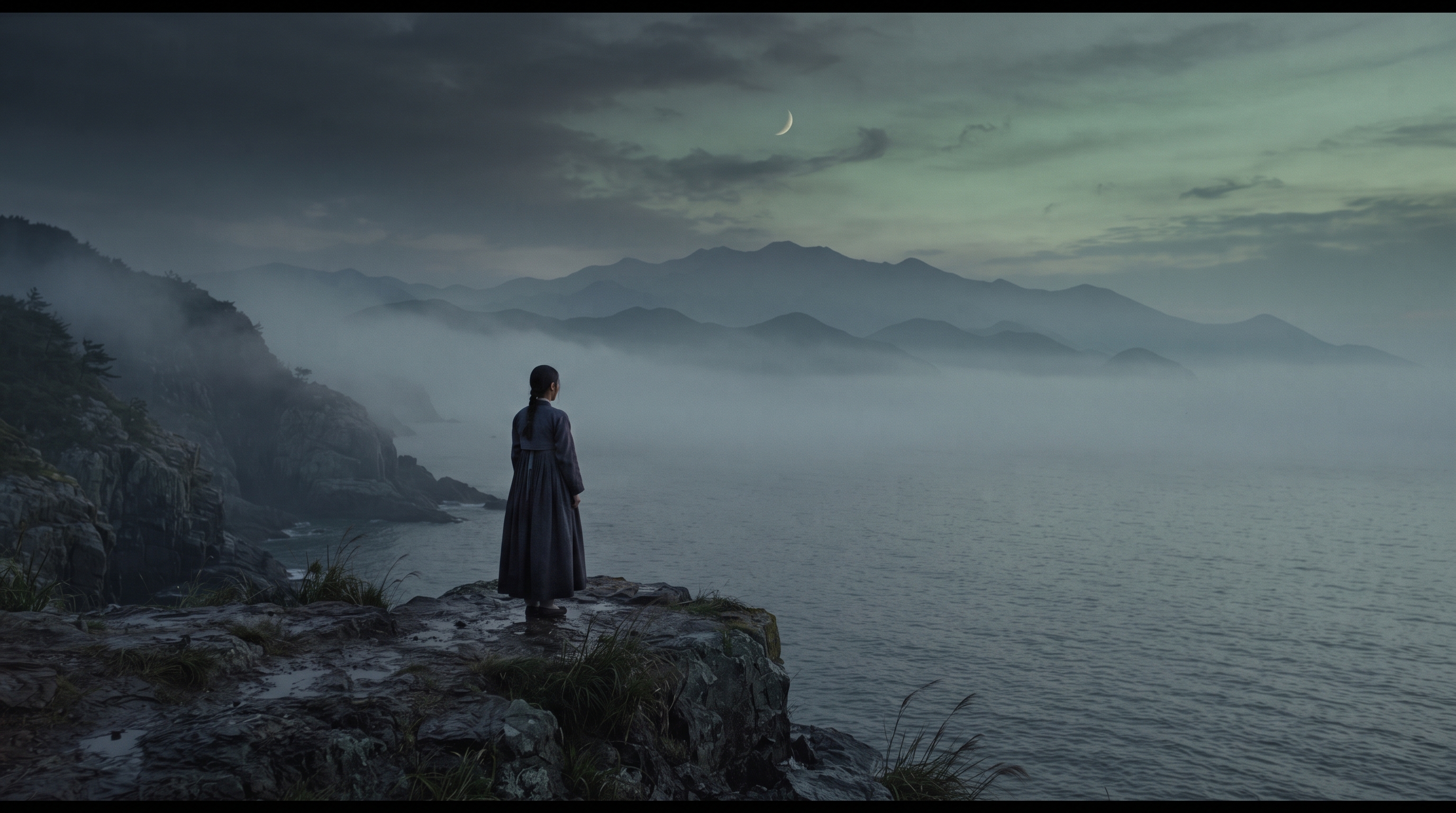
Divided Korea Music hides the most devastating secrets behind beautiful melodies. Let’s cut the bullshit. When you press play on this track, your first thought will likely be: “This sounds like a beautiful, hopeful 2000s K-drama love song.” You will hear a gentle 78BPM piano, warm orchestral strings, and a soulful female vocal whispering, “I am looking at that sea again today.”
But you have been deceived. This is not a song about a breakup. This is a meticulously engineered piece of Divided Korea Music, masking one of the most brutal geopolitical tragedies of the modern era behind a veil of cinematic romance.
The Geographic Reality of Monggeumpo
To understand the devastating illusion of this track, you must look at a map. The lyrics sing longingly of the sunset over Jangsangot and the wind over the sea of Monggeumpo.
Here is the cold, hard truth: Monggeumpo and Jangsangot are located in Hwanghae Province—in North Korea. They are territories locked strictly behind the Northern Limit Line (NLL). When the vocalist sings, “Will I meet my love today?” she is not looking down a street. She is standing at the heavily guarded border, staring across the sea at a homeland and family she has not seen in 70 years. By classifying this as Divided Korea Music, we reveal that the “waiting” in the lyrics is not romantic patience; it is the agonizing, generational trauma of separated families.
Audio Engineering False Hope: The 78BPM Illusion
Why did we wrap such a massive national tragedy in the warm, hopeful sounds of a 2000s Emotional Ballad?
In audio engineering, contrast creates the deepest wounds. The early 2000s marked the era of the “Sunshine Policy” in South Korea—a brief period of inter-Korean summits and reunions where reunification actually felt possible. The 78BPM tempo, the hopeful orchestral swells, and the gentle Gayageum (traditional zither) perfectly emulate that specific era of immense hope.
However, listening to this track in 2026 creates extreme cognitive dissonance. We now know that the hope of the 2000s was an illusion. The border remains closed. Therefore, the warm, hopeful strings in this track do not represent joy—they represent the cruelest form of “false hope.” The ambient sound of the waves at the beginning and end of the track is not romantic; it is the sound of the indifferent sea that physically divides a nation. https://hansori-kr.com/

💡 DECRYPTED QUERIES: Unmasking Divided Korea Music
Q: Why does this specific piece of Divided Korea Music sound so hopeful and romantic instead of dark or sorrowful?
A: This is a psychological audio technique. By using the bright, emotional chord progressions typical of a 2000s romantic ballad, the track captures the fragile, desperate hope of separated families. The tragedy hits much harder when you realize that the joyous reunion the vocalist is singing about will likely never happen in reality.
Q: What is the significance of the traditional Gayageum paired with modern orchestral strings?
A: The Gayageum represents the ancient, unified soul of the Korean peninsula before the division, while the modern cinematic strings represent the passage of time. Together, they create a sonic bridge over a physical border that cannot be crossed.
🩸 END OF RECORDING: The Sea Remains Silent
The most heartbreaking songs are not the ones where the singer is crying. The most heartbreaking songs are the ones where the singer is smiling, desperately holding onto a promise that history has already broken.
Do not just listen to this as a love song. Listen to the 78BPM heartbeat of a divided nation. Put on your headphones, close your eyes, and face the sea.
👉 [ACTION REQUIRED] Experience the beautiful tragedy of Monggeumpo. Watch the full visualizer on our Official YouTube Channel: https://youtube.com/@hansori_kr
댓글 남기기